
CEOs do not buy consultancy because they want more advice. They buy it because there is a decision they need to make and they want greater confidence that they are making the right one.
That decision might be whether to replace a core platform, whether the technology team is capable of supporting the next stage of growth, whether the business is investing at the right level, or whether a proposed transformation programme is really necessary. It might be about security, an acquisition, a supplier relationship or a technology roadmap that looks convincing but has never really been challenged against the needs of the business.
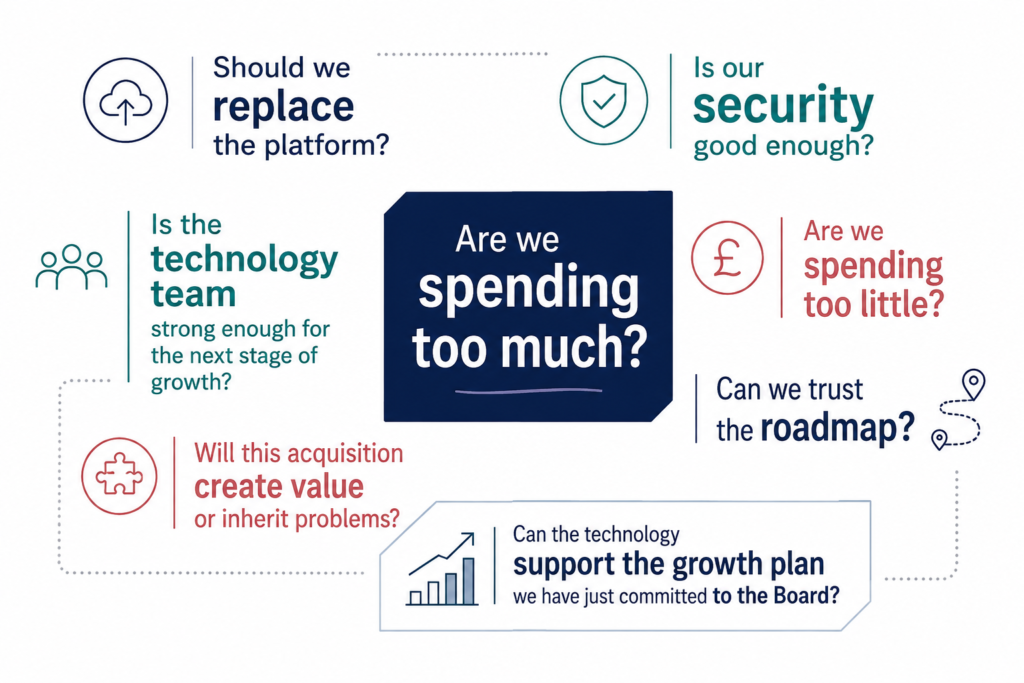
These are all technology questions, but they are also much more than that. The CEO needs to understand what the available choices mean for the business, what risks sit behind each choice and what will happen if the organisation chooses not to act. They need enough understanding to make the decision, explain it to the Board and then move forward without continually reopening the argument.
That is where good consultancy creates value. The report, assessment, roadmap or strategy is part of the process. The real outcome is confidence that you are making the right technology decisions.
The real product is confidence
Most consultancy is described in terms of activity. We talk about reviews, assessments, strategies, roadmaps, transformation programmes, architecture reviews and due diligence exercises because those descriptions help define the work that will be undertaken.
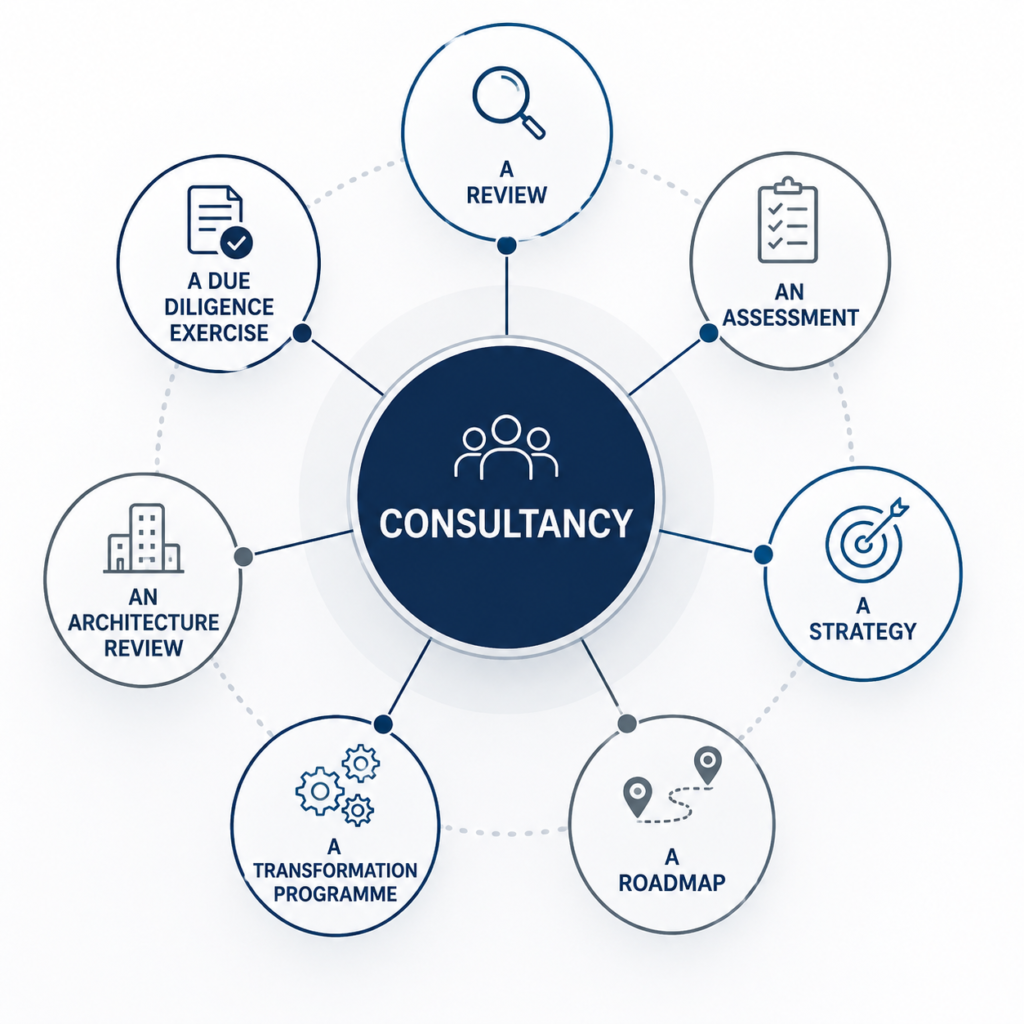
They are not normally the thing the client actually needs.
I’ll be bold and say that if you commission a technology assessment, you probably do not really want an assessment. You want to understand whether your technology is capable of supporting the business and, if it is not, what you should do about it.
Perhaps you are considering an acquisition and need to understand what you will actually be buying. Growth may have exposed weaknesses that were manageable when the company was smaller. Technology costs may have increased without an obvious improvement in business performance. Your CTO may be proposing a substantial investment and you want independent assurance that the argument is sound.
In each of those cases, the assessment is the mechanism. Confidence is the outcome.
That distinction is important because it changes how you judge whether the work has been successful. A consultancy engagement can be thorough, technically correct and beautifully presented while still failing to give the executive team what it needs. Producing good analysis is only part of the job. The analysis has to help the organisation make a better decision.
More information does not necessarily create more confidence
Most executives do not suffer from a shortage of information. The harder problem is working out which information matters and what it means.
Modern technology organisations produce enormous quantities of data. There are security reports, project dashboards, service metrics, architecture diagrams, development statistics, risk registers, infrastructure reports, supplier reviews and budgets. All of them can contain useful information, but simply putting more information in front of an executive does not necessarily improve the decision they are trying to make.
If you, as CEO, ask whether the technology organisation is capable of supporting the next three years of growth, fifty pages of findings might demonstrate that a detailed assessment has taken place, but the volume of analysis is not the measure of its value. The important question is whether you now have a clear understanding of where technology could constrain growth, what needs to change, how urgent those changes are and what level of investment is justified.
This is one of the most important parts of any technology assessment or due diligence exercise. You take a technology view to understand the environment, but you add value to that assessment by using a business lens to prioritise what you have found.
Some technical weaknesses will represent significant business risks. Others will be perfectly acceptable compromises for an organisation of that size and at that stage of development. Some problems need action now. Others can wait. Occasionally, something that initially appears to be a technology problem turns out to be an operating model, leadership or governance problem instead.
The purpose of the work is to make those distinctions clear.
Confidence does not mean certainty
There is an important difference between confidence and certainty, particularly when dealing with technology. Good leadership does not require certainty because technology rarely offers it.
Architecture involves trade-offs. Transformation programmes carry execution risk. Security investment reduces risk rather than eliminating it. Product decisions are made with incomplete information. New technologies develop faster than most organisations can absorb them, and even apparently straightforward platform decisions can have consequences that only become visible several years later.
Waiting for certainty means waiting forever.
What a CEO needs is enough understanding of the uncertainty to make a rational decision despite it. A strong adviser should be able to distinguish between what we know, what the evidence suggests, what remains uncertain and what assumptions are being made. They should also be able to explain the risk of proceeding and, just as importantly, the risk of doing nothing.
That last part is often missed. Doing nothing is still a decision.
If a platform is becoming a constraint on growth, delaying replacement has a consequence. If security controls are inadequate, accepting that position carries a risk. If a critical supplier relationship is deteriorating, retaining the supplier is not the absence of a decision. It is a choice to continue with the existing risk.
Confidence comes from understanding those choices properly. It does not come from pretending that uncertainty has disappeared.
Good consultancy should reduce the number of questions
Poor consultancy creates work. A report arrives and immediately generates another programme of investigation, more workshops, more analysis and potentially another workstream. Instead of the original uncertainty becoming clearer, the number of questions increases.
Sometimes further investigation is genuinely necessary. Complex problems cannot always be resolved through a single assessment, particularly where information is missing or significant decisions have deliberately been deferred. But consultancy should normally reduce uncertainty rather than manufacture dependency.
A good engagement progressively narrows the decision.
You might start by asking whether the company needs to replace a technology platform. Through the assessment you may discover that the platform itself is not actually the principal problem. Perhaps the architecture can support the expected growth but the operating processes around it cannot. Alternatively, you may confirm that replacement is necessary but reduce a very broad technology question to a much more manageable choice between two viable approaches.
That represents progress because the organisation has moved from a loosely understood concern towards a decision it can actually make.
This is also why recommendations need to be prioritised. A long list of findings presented with roughly equal importance pushes the decision back onto the client. If everything is important, nothing is. Good consultancy should make it easier to see where management attention and investment will create the greatest value.
The Board needs a business answer
Technology decisions increasingly reach the Board and that creates its own challenge because the technology team and the Board are looking at the same issue from different perspectives.
An engineer may see scalability, technical debt, resilience and deployment architecture. A security specialist may see threat models, controls and attack surfaces. A data leader may see lineage, governance, quality and architecture. Those perspectives are necessary because without the technical understanding you cannot establish what is really happening.
The Board has a different responsibility. It needs to understand what those things mean for the business.
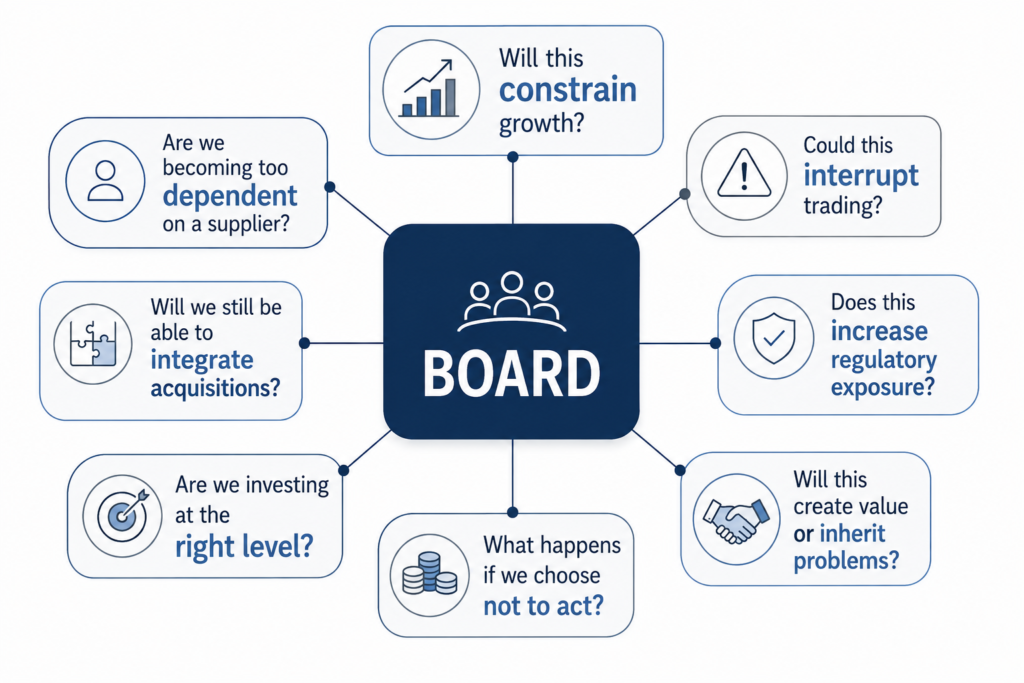
The Board does not need those questions answered by stripping away all of the technical detail. Over-simplification can be just as dangerous as excessive complexity. It needs somebody who can understand the technical evidence well enough to translate its significance without losing the substance behind it.
That translation is where a technology adviser can add significant value. The technical assessment tells you what is happening. The business lens tells you why it matters. Putting the two together gives the Board something it can use to make a decision.
Independence matters when the decision matters
None of this suggests that internal technology leaders should not have strong views. Quite the opposite. You employ a CTO, CIO or technology director partly because you expect them to understand the environment and make recommendations about what should happen next.
There are, however, points where the importance of a decision makes independent challenge valuable.
Consider a CTO recommending a major platform replacement. They may be entirely correct, but they may also have spent months developing the proposal. Their leadership team may already support it, significant technical work may have gone into evaluating the options and their personal credibility may now be associated with the programme going ahead.
None of that invalidates their judgement. It simply means that asking somebody independent to challenge the assumptions before committing substantial money and several years of organisational effort can be entirely sensible.
The same applies to acquisitions, funding rounds, significant supplier changes, cybersecurity investment and major transformation programmes. The larger the consequence of being wrong, the greater the value of testing the decision before making the commitment.
Importantly, independent advice does not need to produce a different answer to be valuable. Across assessments and due diligence work, the strongest outcomes are when independent scrutiny confirms that the existing leadership team has understood the problem correctly and is proposing a proportionate response.
Think about that for a moment. If your internal team proposes a course of action, and an external advisor agrees and supports their plan then how do you feel? You immediately gain greater confidence because the argument has been tested rather than simply accepted.
Confidence comes from challenge, not reassurance
An adviser who agrees with everything the executive team already believes is not creating confidence. They are creating reassurance, and the two are very different.
Useful challenge means being prepared to test the assumptions underneath the proposed solution. Do we genuinely need a new platform, or could we change the operating model around the one we already have? Is this actually a technology problem? Will AI materially improve this process, or are we introducing it because we feel we should be doing something with AI? Are we replacing a product because it is fundamentally inadequate, or because it has been poorly configured? Are we considering an enterprise-scale solution for a problem that simply does not require one?
These questions can be uncomfortable because they sometimes challenge work that has already been undertaken or assumptions that have become embedded in the organisation. That is precisely why they need to be asked before the investment is made.
The objective is not to disagree with the internal team. Nor is it to create an alternative strategy simply to demonstrate that an external adviser has added something new. The objective is to improve the quality of the decision.
Sometimes the challenge strengthens the original proposal. Sometimes it changes it. Occasionally it shows that the organisation is solving the wrong problem entirely. All three outcomes are useful.
Confidence has an economic value
Confidence can sound intangible until you consider what uncertainty actually costs an organisation.
Uncertainty delays decisions. A transformation starts six months later than it should. A weak supplier remains in place for another year. Technical debt continues to grow. A security weakness remains unresolved. A product investment is postponed while the same arguments are repeatedly revisited. A leadership problem continues because nobody is sufficiently confident about the action required.
Those delays have a cost.
The opposite reaction can be equally expensive. Organisations that are uncertain about their technology position sometimes respond by over-investing. They buy larger platforms than they need, launch transformation programmes without properly understanding the problem, increase team sizes before defining the capabilities required or replace systems that could have been improved for a fraction of the cost.
Better confidence improves capital allocation because it helps the organisation distinguish between the areas where intervention will create value and those where the current position is good enough.
That does not mean always spending less. Sometimes the outcome of an assessment should be that the company needs to invest considerably more than it currently does. The point is that management should understand why that investment is necessary, what business outcome it supports and what risk it is addressing.
That is a much stronger basis for investment than simply being told that something is best practice.
A roadmap should help the business make decisions
The same principle applies when a roadmap is created.
A roadmap is not valuable simply because it contains a sequence of technology projects. A project list tells you what the organisation intends to do. A useful roadmap explains why those things should happen, why they are in that order and what business outcomes the investments are intended to create.
If the business intends to expand internationally, the roadmap should make clear which technology capabilities are necessary to support that expansion. If the objective is to improve margin, there should be an identifiable connection between technology investment and simplification, automation or operating efficiency. If the business is preparing for investment or exit, scalability, governance, security, data and resilience should be considered in the context of what a future investor or acquirer will expect.
This creates a much stronger conversation at Board level. Instead of discussing technology investment as a collection of disconnected costs, the Board can see how the work supports the direction of the business and can challenge whether those priorities remain appropriate as circumstances change.
The roadmap becomes part of the mechanism through which the organisation maintains confidence in its technology direction.
Good advisers make the client stronger
There is another test I use when thinking about the value of consultancy. The organisation should be better able to make technology decisions after the engagement than before.
That might sound commercially counterintuitive, but the strongest advisory relationships are not built by making the client dependent on the adviser. They are built by helping the leadership team understand the problem, improving the way decisions are made and being available when independent experience or additional leadership capacity is genuinely useful.
If an engagement improves governance, clarifies priorities, strengthens the internal leadership team and gives the CEO a better way to evaluate future technology decisions, then it has created something more durable than a report.
That does not necessarily mean the relationship ends. In many cases it changes.
The organisation may no longer need somebody to investigate every technology question, but it may still benefit from independent Board advice, fractional leadership, support during an acquisition or periodic challenge as the strategy develops. The relationship becomes one in which the adviser is used where they add value rather than because the organisation has become dependent on them.
That is a much healthier form of consultancy for both sides.
Know what you are buying
Before commissioning technology consultancy, there is a simple question worth asking:
What decision will we be better able to make when this work is finished?
If there is no clear answer, I would question whether the engagement has been defined well enough.
The output might still be an assessment, a strategy, a roadmap, an architecture review or a due diligence report. Those are all legitimate and useful deliverables, but they are not the ultimate test of whether the work has created value.
The test is whether you understand your technology position better than you did before. Whether the important risks are clearer. Whether you can distinguish between what needs attention and what does not. Whether the available choices and their trade-offs are understood. Whether investment priorities are easier to defend and whether the Board can see how technology supports the direction of the business.
Most importantly, you should be better able to make the decision that caused you to commission the work in the first place.
Because the consultancy is not really what you are buying.
You are buying the confidence to act.