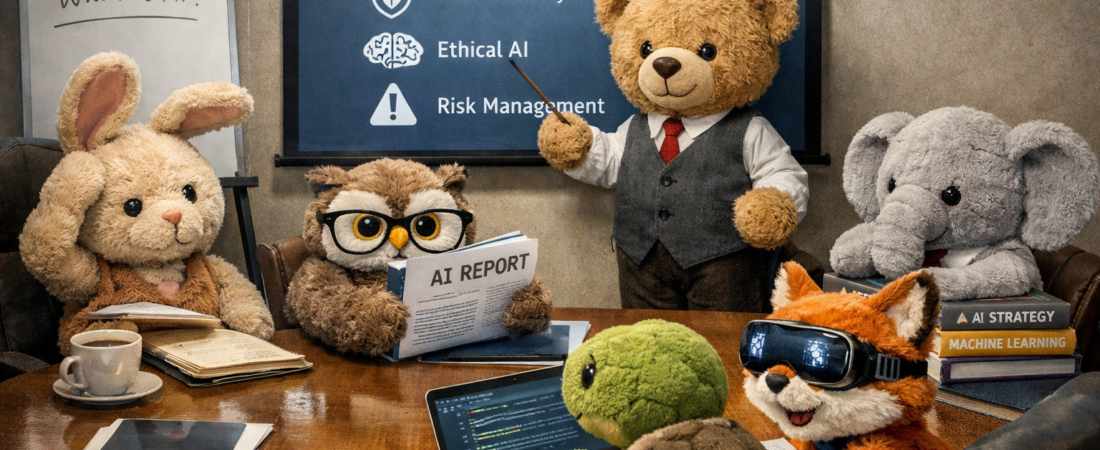
Walk into almost any boardroom today and you will see three very different perspectives on artificial intelligence.
One director may not use AI at all and is still trying to understand where it fits into the business landscape. Another may have read about it extensively but has little practical exposure beyond headlines and vendor promises. A third may be actively experimenting with it and pushing for rapid adoption across the organisation.
All three viewpoints can exist around the same table.
This diversity of experience is not surprising. Board members come from different professional backgrounds and industries. Some sectors have been exposed to automation and data science for years, while others are only now encountering AI driven tools in their daily operations.
Company size does not remove that difference. In fact, in smaller organisations it can make it more pronounced. Larger enterprises often have internal technology teams, risk functions and governance structures that help translate technical developments for the board. In SMEs those buffers are thinner. Directors are closer to operational decisions, and the pace of change can feel both faster and less structured.
The result is a common dynamic. The organisation may already be using AI in sales, operations or product development, yet the board has not developed a shared understanding of what that means in practice.
In 2026 that gap is becoming harder to ignore.
Boards do not need to understand the technical details of models or prompts. They do, however, need to ensure that AI is governed with the same discipline as any other critical capability. The starting point is not technical depth but structured questioning.
There are five questions that directors should now expect clear answers to.
The first is simple visibility.
Where is AI used across the organisation?
This sounds straightforward, yet many leadership teams cannot provide a comprehensive answer. AI appears in marketing tools, operational dashboards, product features and automated workflows. Without a clear inventory, boards cannot assess exposure or opportunity.
The second question concerns decision impact.
What decisions are influenced by AI outputs?
AI that drafts marketing copy presents a different risk profile from AI that informs pricing, underwriting, resourcing or eligibility decisions. Directors must understand where automated outputs influence outcomes that affect customers, revenue or reputation.
The third question relates to data.
What data informs those systems and how is it governed?
AI reliability depends entirely on the integrity and lineage of the data it consumes. If data ownership is unclear, definitions are inconsistent or governance is weak, AI will amplify those weaknesses rather than resolve them.
The fourth question is ownership.
Who is accountable for each AI capability?
Many organisations have AI tools but no defined owner. A model may have been implemented by a product manager, a data analyst or a vendor integration, but no individual is responsible for monitoring performance, reviewing risk or ensuring compliance.
Without clear ownership, governance becomes impossible.
The last question concerns resilience.
What happens if the AI stops working or produces unreliable output?
Boards should expect clear fallback processes and monitoring mechanisms. AI systems fail differently from traditional software. They may drift, degrade or produce inconsistent outputs without triggering obvious errors. Organisations must be prepared for that possibility.
These questions are not intended to slow adoption. They create the foundation for sustainable innovation.
When AI usage is visible, owned and governed, boards gain confidence to support further investment. When it is informal and undocumented, it becomes a source of uncertainty.
This is precisely why structured governance frameworks are becoming essential. Organisations need a practical way to map AI usage, define ownership and align technical controls with board oversight.
At DigitalTeddy, we have developed three complementary products to support that journey. Together they help organisations move from informal experimentation to governed AI capability.
The first creates visibility by mapping where AI exists across the organisation and what it influences.
The second establishes ownership and governance controls so that responsibility is clearly defined and risks are proportionate.
The third aligns those governance artefacts with recognised standards and emerging expectations around AI oversight.
For boards, the objective is not to become experts in AI technology. It is to ensure that the organisation understands, governs and ultimately benefits from it.
In 2026, the organisations that achieve that balance will not only reduce risk. They will also build the confidence required to innovate at scale.